Professional Introduction to the Continuous Casting Machine
1. What is a Continuous Casting Machine?
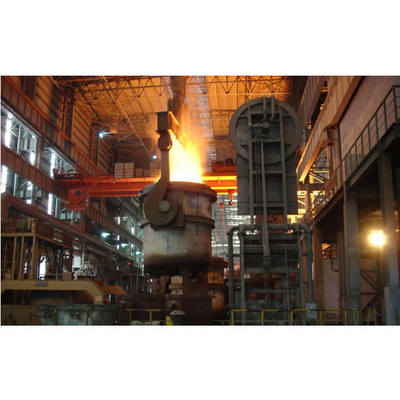
The process of continuously casting high-temperature molten steel into solidified strands of a specific cross-sectional shape and size is known as continuous casting. The integrated system of equipment required to accomplish this process is termed a continuous casting machine. This core steelmaking apparatus, traditionally called a continuous caster, represents a sophisticated electromechanical-hydraulic system. It primarily integrates steel-pouring equipment, the caster body itself, the cutting area machinery, and dummy bar handling systems.
2. Key Components of a Continuous Caster
A standard continuous caster comprises several major subsystems and components, including:
Ladle Turret or Ladle Car
Tundish
Stopper Rod Hoist Device / Slide Gate System
Tundish Car
Tundish Overflow Tank
Tundish Cover and Mold Cover
Mold (Crystallizer) – A core component
Mold Oscillation Device
Strand Guide & Support Segment (including rolls)
Secondary Cooling Spray System
Straightener / Withdrawal-Straightener Machine (for curved casters)
Dummy Bar
Dummy Bar Storage & Disconnection Track
Run-out Table / Cooling Bed
Pusher Machine
Comprehensive Water Cooling System
Hydraulic Power Unit & Piping
Electrical Control & Automation Systems
3. Technological Process of a Bloom/Billet Caster
The operation follows a precise sequence:
1. A ladle containing refined molten steel is transported and positioned on the ladle turret.
2. The turret rotates the ladle to the pouring station, where the steel is released into the tundish—a distribution reservoir.
3. From the tundish, the molten steel flows through submerged entry nozzles (SENs) into one or multiple water-cooled copper molds (crystallizers).
4. The mold, a core component, initiates rapid solidification, forming a stable shell around the still-liquid core.
5. Coordinated with the mold's oscillatory motion, the withdrawal/straightening unit gently pulls the strand downward.
6. The strand then enters the secondary cooling zone, where controlled water sprays continue the solidification process. Electromagnetic stirring may be applied here to improve internal structure.
7. Once fully solidified, the continuous strand is cut to specified lengths by a cutting device (torch or shear), producing slabs, blooms, or billets ready for further rolling.
4. Automation in Continuous Casting
Modern casters rely heavily on automatic control systems, which primarily manage:
Strand Withdrawal Speed Control
Mold Oscillation Frequency & Stroke Control
Liquid Level Control in the Mold
Secondary Cooling Water Flow Control
Fixed-Length Cutting Control
5. Production Significance
The continuous casting process revolutionized steelmaking by replacing the traditional, batch-oriented ingot casting and primary rolling route. It directly converts molten steel into semi-finished shapes in a continuous flow. This innovation delivers profound benefits:
Simplified Production Flow: Eliminates several intermediate processing steps.
Increased Productivity & Yield: Significantly higher metal yield (reduced scrap) and throughput.
Energy Efficiency: Major savings in energy consumption.
Reduced Costs: Lower operational and capital costs per ton.
Improved Quality: Superior and more uniform internal and surface quality of the cast product.
Consequently, the continuous casting machine has become an indispensable, nearly ubiquitous facility in all modern steel plants, integral to both long-process (integrated) and short-process (mini-mill) steelmaking routes.
We are a professional electric furnace manufacturer. For further inquiries, or if you require submerged arc furnaces, electric arc furnaces, ladle refining furnaces, or other melting equipment, please do not hesitate to contact us at susan@aeaxa.com


 Your message must be between 20-3,000 characters!