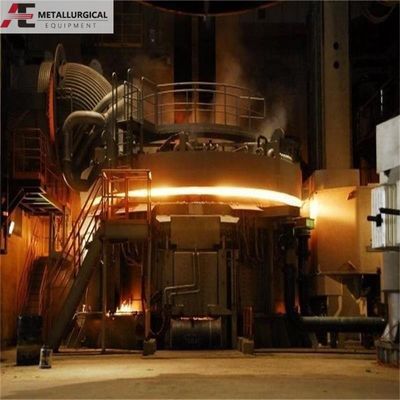
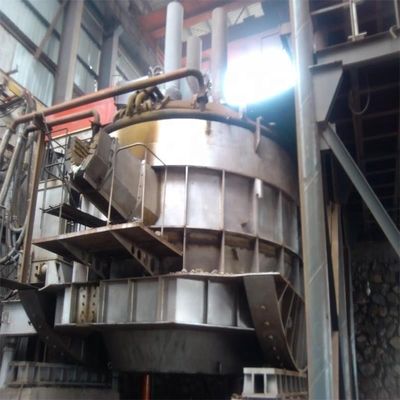
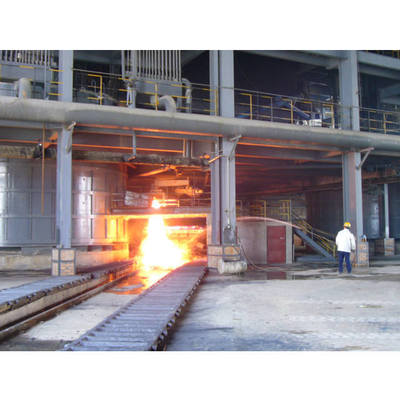
Electric Furnace Steelmaking Production: A Rapidly Evolving Sector
Currently, the electric furnace steelmaking method is experiencing swift development and growth, with its expansion rate outpacing that of the world's total crude steel production.
In major steel-producing nations globally, electric arc furnace (EAF) steel constitutes over one-third of the total output. For instance, in 1990, the United States produced 33.511 million tons of EAF steel, accounting for 37.3% of its total crude steel output of 89.726 million tons. In the same year, Japan's EAF steel represented 31.4% of its total steel production, while the European Community's EAF steel accounted for 31%.
The Rapid Development of Electric Furnace Steelmaking Production
① Short-Process Advantage: The electric furnace steel plant adopts a short-process production method. Compared to integrated blast furnace-converter plants, it saves on investment by 25%, reduces the required area by half to three-fifths, and shortens the construction period from four years to one to one and a half years.
② Energy Efficiency: When compared to the blast furnace-converter steelmaking process, energy consumption in EAF steelmaking drops from 5469 MJ/t steel to 2877 MJ/t steel, roughly halving the energy requirement.
③ Market Adaptability: The integration of electric arc furnaces with external refining and continuous casting, followed by high-efficiency continuous rolling mills, enables better adaptation to product specialization, variety diversification, and evolving market demands.
④ Scrap Steel Accumulation and Metallized Pellet Production: After the 1950s, following the replacement of open-hearth furnaces with oxygen converters, the accumulation of scrap steel in industrialized countries surged. Additionally, the development of metallized pellet production served as a significant catalyst for the growth of electric arc furnace steelmaking.
⑤ Environmental Control: The primary sources of environmental pollution from electric furnace steelmaking plants are smoke and noise generated during the smelting process, both of which are relatively easy to control.
⑥ Technological Advancements and Versatility: With the development of ultra-high-power electric furnace technology and out-of-furnace refining techniques, EAF production has transitioned from being primarily confined to the special steel sector to encompassing the production of all steel types. Its high efficiency, flexibility, low cost, and short process, coupled with high quality, have endowed it with remarkable vitality in the fiercely competitive market.
⑦ Technological Breakthroughs: Significant progress in electric furnace technology has laid a solid foundation for the expansion of electric furnace production, ensuring its continued growth and relevance in the steel industry.
In summary, electric furnace steelmaking production is rapidly evolving, driven by technological advancements, energy efficiency, market adaptability, and environmental considerations. Its growth trajectory underscores its increasing importance in the global steel production landscape.
We are a professional electric furnace manufacturer. For further inquiries, or if you require submerged arc furnaces, electric arc furnaces, ladle refining furnaces, or other melting equipment, please do not hesitate to contact us at susan@aeaxa.com


 Your message must be between 20-3,000 characters!