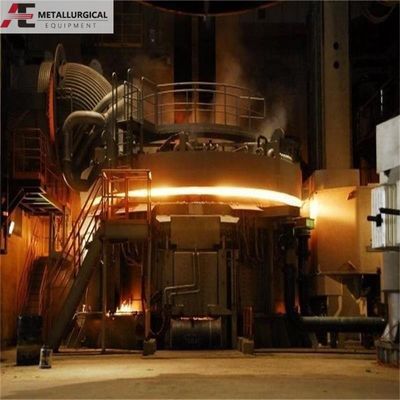
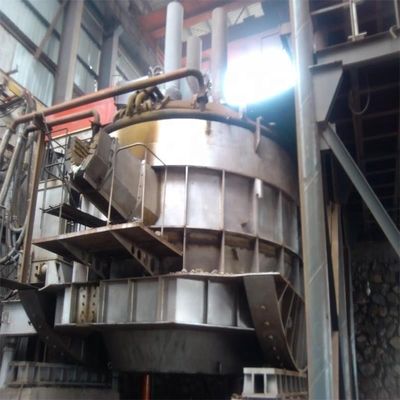
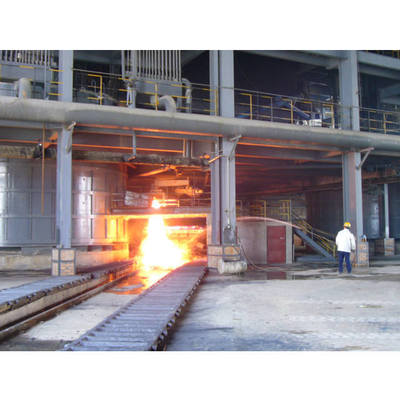
Comparison Between Electric Arc Furnaces and Medium‑Frequency Induction Furnaces
Medium‑frequency induction furnaces exhibit distinct refining capabilities and process adaptability compared to conventional electric arc furnaces (EAFs). The following outlines their key differences in refining performance and operational characteristics.
1. Refining Capacity
- Dephosphorization and Desulfurization:
EAFs outperform induction furnaces in removing phosphorus and sulfur, primarily due to slag conditions. In EAFs, the arc directly heats the slag (“hot slag”), enabling active slag‑metal reactions that effectively remove impurities. Induction furnaces rely on heat transferred from the molten metal (“cold slag”), resulting in less reactive slag and limited desulfurization/dephosphorization capability.
- Gas Content and Alloy Recovery:
EAFs tend to yield higher nitrogen levels because arc ionization dissociates nitrogen molecules, which are then absorbed by the melt. Induction furnaces generally produce steel with lower nitrogen but higher oxygen content. Alloy recovery rates are typically higher in induction furnaces, as arc‑related volatilization and oxidation losses are reduced.
2. Alloy Element Yield
Alloying elements exhibit higher recovery in induction furnaces due to lower oxidation and volatilization losses. In EAFs, high arc temperatures promote oxidation, especially when melting returns (recycled scrap). For example:
- Aluminum recovery: induction furnace 92‑96% vs. EAF 85‑90%
- Tungsten recovery: induction furnace 90‑94% vs. EAF 85‑90%
Induction heating minimizes burn‑off, making it more efficient for recovering valuable alloys from returns.
3. Carbon Control
Induction heating introduces no external carbon, allowing the production of very low‑carbon melts (e.g., down to 0.020% C). In contrast, EAFs use graphite electrodes, which inevitably increase carbon content (typically ≥0.06% C). This makes induction furnaces particularly suitable for low‑carbon, high‑alloy steels and specialty alloys.
4. Stirring and Reaction Kinetics
Induction furnaces generate inherent electromagnetic stirring, which enhances reaction kinetics, accelerates temperature and composition homogenization, and improves inclusion flotation. While EAFs can be equipped with electromagnetic stirrers, their stirring efficiency generally remains below that of induction systems. Excessive stirring in induction furnaces, however, may hinder inclusion removal and accelerate refractory wear.
5. Process Control
Induction furnaces allow more precise control over temperature, refining time, and stirring intensity. Operators can easily maintain steady temperatures and adjust parameters throughout the process, offering greater flexibility compared to EAFs.
6. Applications
Given their advantages in alloy recovery, carbon control, and stirring, medium‑frequency induction furnaces are widely used for high‑alloy steels, stainless steels, tool steels, electrical alloys, precision alloys, and high‑temperature alloys. They can serve as standalone melting units or be combined with secondary refining processes (e.g., electroslag remelting, argon‑oxygen decarburization) in duplex refining routes.
In summary, while EAFs offer stronger oxidative refining and impurity removal, induction furnaces excel in precise composition control, high alloy yield, and low‑carbon melting—making each suitable for distinct metallurgical requirements.
We are a professional electric furnace manufacturer. For further inquiries, or if you require submerged arc furnaces, electric arc furnaces, ladle refining furnaces, or other melting equipment, please do not hesitate to contact us at susan@aeaxa.com


 Your message must be between 20-3,000 characters!